Memories of Franklin Field
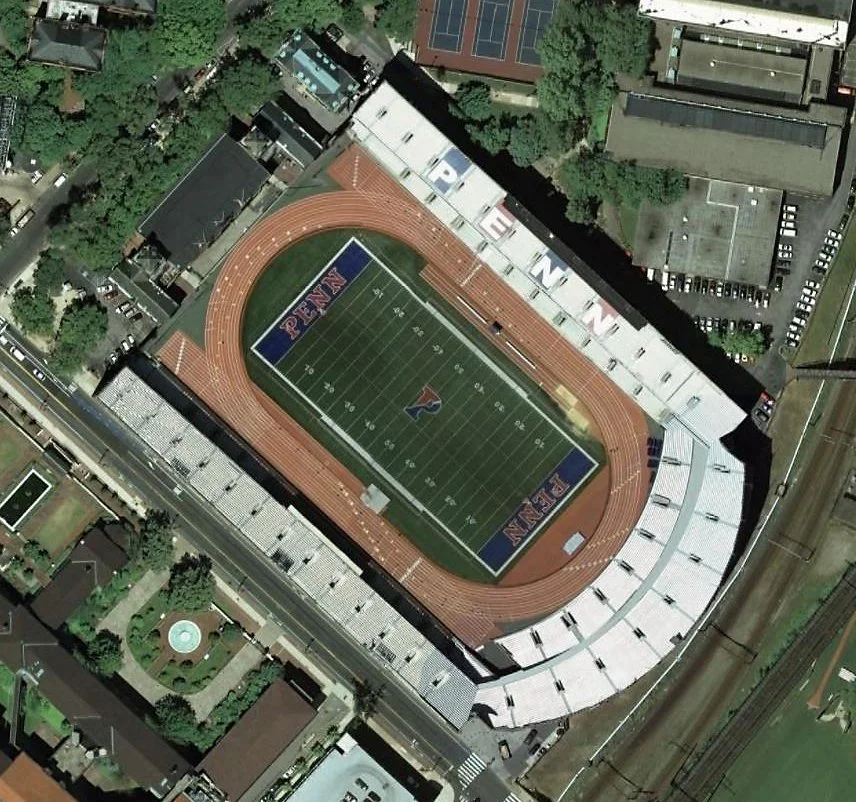
Franklin Field, University of Pennsylvania taken by NASA World Wind (November 2008)
Thirty-one years have passed since I last visited Franklin Field, the historic and venerated stadium that graces the University of Pennsylvania campus in Philadelphia. Moreover, it’s been twenty-five years since I last set foot in the city of Philadelphia. Be that as it may, I have preserved many fond impressions of the city, and of Franklin Field in particular, and during my idle moments I will often retrieve and dwell on those memories. They are creative, idealized memories for the most part, I suspect. A return visit to the city or the stadium would only serve to adulterate the memories, so it’s just as well that I don’t return. At my age, I am happy to harbor a few fantasies.
I was born in Philadelphia, at the old Mt. Sinai Hospital in South Philly, when my parents were both graduate students at U of P. Nine months later, after my parents graduated, I followed them to Plainfield, NJ, and a year later, to Washington, D.C. Only after graduating medical school, in 1962, did I return to my Philadelphia roots - for a neurology residency at historic Pennsylvania Hospital. (Isn’t everything in Philadelphia historic?) I loved my three years at that hospital, as well as my adventurous off-duty forays into Center City and South Philly. But let me focus on my Franklin Field experiences.
During my residency years in Philadelphia, 1963-66, the Philadelphia Eagles of the National Football League adopted Franklin Field - which can accommodate up to 70,000 spectators — as their home field. (The Eagles had outgrown Shibe Park, which was primarily a baseball stadium, and a shiny new football stadium was still in the planning stage.) The Eagles leased Franklin Field for their Sunday football games, while the U of P football team - the Quakers - continued to play there on Saturdays.
A few months into my residency at Pennsylvania Hospital, I examined a patient who was complaining of double vision and headaches, and discovered that the cause of his symptoms was a cerebral aneurysm. Surgery was scheduled for early the next day, a Sunday, and I — having made no plans for that morning — decided to come to the operating room as an observer. As the aneurysm patient was being prepped for surgery, the neurosurgeon, Dr. Langfitt, offhandedly mentioned to those who were present that he had tickets to the Eagles-Steelers football game that afternoon, and he hoped that the surgery might be concluded before the 2 pm kickoff. (Dr. Langfitt, who stood 6 feet, 4 inches tall, had played end on Princeton University’s football team.) Well, cerebral aneurysms are situated deep inside the cranium, at the base of the brain, the surgery is inherently risky, and the surgeon must proceed with utmost caution - and that can result in a very lengthy operation. Shortly after noon, when the end of the procedure was not yet in sight. Dr. Langfitt paused for a moment and asked, “Is there anyone here who could use my tickets to the game?” “Anyone” could only have been me, the only one in the room who was an observer and not part of the surgical team. I gratefully accepted the tickets.
It was a mild, sunny, late October Sunday, perfect football weather. I telephoned my sister, who was a medical student at the U of P and living in an apartment less than a mile distant from Franklin Field, and invited her to join me at the game. She accepted, and we agreed to meet at the stadium gate. I decided that I would walk to the stadium. It is about a half-hour walk from Pennsylvania Hospital, at Eighth and Spruce, to Franklin Field, on South Thirty-third Street. The blocks in Center City Philadelphia are short, and the ambience is pleasant, especially on a sunny day. For the first dozen or so blocks of my trek westward on Spruce St., it seemed to me that I was a solitary walker, but by the time I reached Rittenhouse Square, pedestrians were converging onto Spruce St. from all directions, all headed toward Franklin Field. (It was no doubt easier and cheaper to park in Center City and walk a mile than to park in the vicinity of the stadium.) By the time we approached the pedestrian bridge over the Schuylkill River, I could see a horde of people ahead, forming a funnel that spilled onto the bridge. Everyone seemed to be in a festive - or at least pleasant - mood.
Franklin Field came into view shortly after I crossed the river. At a distance, it appears to be just another, albeit very large, building on the university campus, its ivy-covered red brick walls blending in nicely with those of the nearby administration buildings. The stadium isn’t surmounted by ungainly lighting fixtures or pedestrian ramps, and it doesn’t obtrude on the tranquil landscape of the campus. I had a momentary amerce that a professional football game really doesn’t belong on a college campus. It’s an ethical violation, I was sure, but even an Ivy League university will occasionally compromise its ethics in order to balance its budget, won’t it? Neither did I want to admit that I, about to become a willing spectator at a National Football League game staged in a college stadium, was somehow complicit in this betrayal of academic ethics.
Truth be told, Franklin Field - like most football stadiums of its era — does not prioritize spectator comfort. It is a two-tiered stadium (the first to be built in the U.S., in 1925), in which all the seating is in the form of backless benches — rows and rows of benches. Spectators sit shoulder to shoulder, hip to hip, and decorum requires a good measure of tolerance on all sides (pun intended). But I could appreciate the classical architecture of the stadium -- which bears more than a little resemblance to the Colosseum in Rome --, and I enjoyed the fine weather that prevailed throughout the afternoon. Oh yes, I enjoyed the game, too, which was won by the Eagles. After the game, on my way back home, I stopped at Nathan’s Famous Hot Dogs, in South Philly, for an early dinner. I resolved, then and there, that I would purchase season tickets for the Eagles’ home games – reasonably priced in those days – in the coming year. And I did.
I had two incentives for acquiring season tickets to the Eagles’ games at Franklin Field: First, I was an inveterate football fan, and while the Eagles were not my “home team” – that distinction belonged to the Washington Redskins – Franklin Field was, for me, an attractive and convenient venue for football. Second, I thought that tickets to the games would endear me to the girl I was then dating, who was a diehard Eagles fan. I purchased end-zone seats on the second tier of the stadium, which did provide us with a pretty good view of the action on the field.
At every game, there were a couple of young guys seated behind us who were very loud and sometimes raucous, but they were good-natured and quick to apologize whenever they would bump us from behind. As it so happened, I broke up with my steady girlfriend after the third game of the season, and I invited my cousin Jerry to join me at the next game. I still recall the loud comment, made during a lull in the game by one the young guys seated behind us, to his friend: “Hey, whatever happened to that good-looking chick who always used to sit in front of us? I hope she’ll be coming back.” I don’t think it ever dawned on them that the chick was my date.
At the end of that season, I renewed my season tickets for yet another season (although, alas, my girlfriend and I did not renew.) Then I completed my residency at Pennsylvania Hospital, and it was “goodbye Franklin Field, goodbye Philadelphia.” I was soon off to London, for further training, and then to N.I.H. for my Public Health Service assignment. But that wasn’t quite the end of my connection to Franklin Field and Philadelphia. My eldest daughter was on the track team at her high school in Bethesda, MD., and, in her junior year, her team was invited to compete in the Penn Relays. On her arrival at the U. of P. campus that April, she was smitten by the ivy-covered red brick facades of the dormitories, the academic buildings, and – especially – Franklin Field. She announced that in her senior year, she would be applying for admission to Penn -- and only to Penn, nowhere else. Fortunately, she did gain admission to Penn. (Unfortunately, her track team did not win any team or individual medals at the Penn Relays.)
During my daughter’s four years at Penn, my wife and I visited the campus a few times every year. From Bethesda, it’s an easy automobile trip and an even easier train trip. But it never occurred to me, even though we usually visited on weekends, that I might buy a ticket to a Penn football game. I had not attended any college football game since I was in college myself. It so happened, though, that in the autumn of my daughter’s senior year, late in the football season, both the Penn Quakers and the Princeton Tigers were undefeated (both were 7 – 0), and they were scheduled to play at Franklin Field in mid-November, in a game that would decide the Ivy League title. The game was hyped relentlessly in the local newspapers and TV sports shows, and it even received some national attention. This would be the most significant college football game, readers and viewers were assured, to have been played in Philadelphia in several decades.
The weekend of the Penn-Princeton game coincided with Parents Weekend at the U of P., and my wife and I came for the weekend. My daughter insisted that we purchase tickets to Saturday’s soon-to-be historic game. I was amenable to that proposal, so four of us – my daughter, my wife, and I, and my cousin Jerry – joined thirty-five thousand other enthusiastic football fans who came to cheer on the Penn Quakers. A large majority of the spectators had not, I am sure, ever before attended a Penn football game, but were motivated to buy tickets because of the hype surrounding this game. (The usual attendance for a football game at Franklin Field was, since the 1950s, between five and six thousand spectators.) The game was well played and closely contested for the first half, but the Quakers pulled away in the second half and won a decisive victory and the Ivy League title.
What impressed me more than the game itself, however, was the sheer size of the players on both sides. The interior linemen, from tackle to tackle, all weighed between 295 and 305 pounds. Aside from a handful of running backs and defensive backs, no player weighed less than 200 pounds. And these guys, I should emphasize, were competing in the no-athletic-scholarship Ivy League! I was put in mind of a cousin of my father’s who played quarterback for the Penn Quakers in the late 1920s: he weighed 165 pounds and was named to the All-America team in 1929. Question: what sort of feedlots are colleges nowadays providing for their varsity football players?
I would be remiss if I did not recall another remarkable experience at that Penn-Princeton game. It has long been a custom when the Penn football team plays at home, in Franklin Field, for the undergraduate spectators, seated in the student section of the upper tier, to sing the Alma Mater Fight Song at halftime. The lyrics of the song, “Drink a Highball,” conclude with “Here’s a toast to dear old Penn” -- whereupon the students all fling slices of toasted bread onto the field below. It’s an amusing and rather endearing custom. But at the Penn-Princeton game that I attended, it was a truly a hilarious spectacle, owing to the uncommonly large number of students who participated in the ritual: Rather than the usual attendance of a few hundred students at a Penn home game, now there were about two thousand students, all casting pieces of toast onto the field or onto the spectators in the lower tier. With some practice, a piece of toast can be made to sail almost like a frisbee, and from my vantage point, at least fifty yards away from the student section, two thousand slices of toast sailing through the air had the effect of a blizzard that temporarily blotted out the sun. Wow! Good show!
My daughter’s graduation from the U of P the following spring provided me with one more opportunity to visit Franklin Field. The ceremony in the stadium was staged with such over-the-top pageantry that, from my perspective, it easily outshone the previous year’s Penn-Princeton game. The academic procession into the stadium – beginning with the President of the University and the Provost and their honored guests, followed by the faculties of the various undergraduate and graduate schools, and finally the graduates themselves, all adorned with colorful caps and gowns and cowls – was awesome. The procession seemed endless, consuming nearly half an hour, and the band playedElgar’s Pomp and Circumstance and the Trumpet Voluntary over and over again. But the procession wasn’t the least bit boring; it was thrilling. It’s true that the speeches afterward were boring, but hey! That was the price of admission, wasn’t it? (No, not really. That’s another fantasy of mine. The real price of admission was the $100,000 that I paid for my daughter’s tuition.)
Ben Franklin’s imprint is all over the city of Philadelphia. Many institutions and public places are named after Franklin – including the Franklin Institute, the Benjamin Franklin Museum, the Ben Franklin Bridge, and the Ben Franklin Parkway -- but not the university that he founded, the University of Pennsylvania. The institution of higher learning that Franklin did found was originally chartered as the Academy of Philadelphia, later renamed the College of Philadelphia, but not until 1791 was the name changed by an act of the state legislature to the University of Pennsylvania. There is a modest statue of Ben Franklin situated in the center of the U of P campus, but the most prominent testimonial to his role in furthering higher education in the City of Philadelphia is … Franklin Field! The great man would no doubt have appreciated this irony -- while I, oblivious to the irony, am appreciative of the many pleasurable hours that I experienced years ago at Franklin Field.
About the author:
Elliot Wilner is a retired neurologist living in Bethesda, MD. In retirement, he has enjoyed -- with his wife's indulgence -- a long-deferred dalliance with creative writing.