Beach House
You can find Brian on Instagram @pettiplays, on Facebook @Brain C. Petti, and through his website, https://bcpkid.wixsite.com/pettiplays
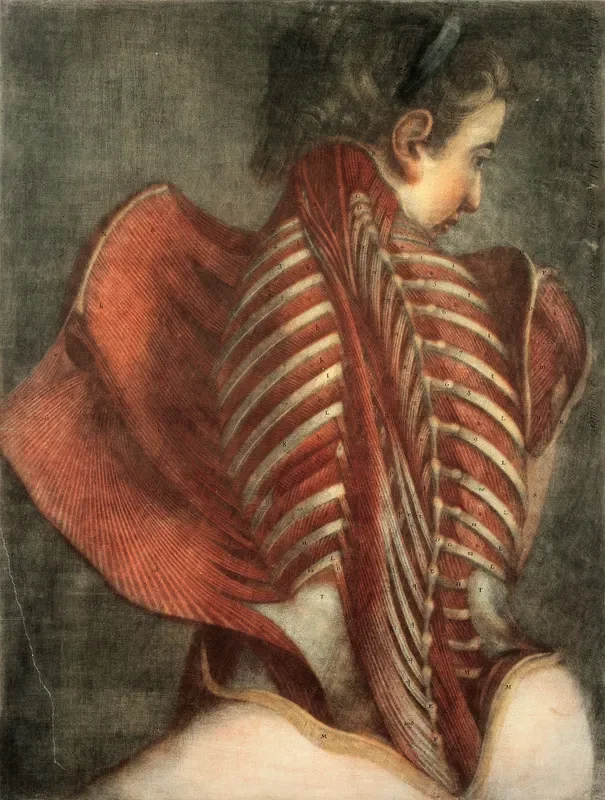
Écorché of a Woman’s Back by Jacques Fabien Gautier d’Agoty (1746)
Character Breakdown:
Andrea (F, 40+) self-assured on the surface, but still suffering acutely from childhood sexual abuse
A bare stage. ANDREA, a woman in her forties, addresses the audience.
ANDREA
The first person I told was my sister, and by then it had already been three summers. She told my father and my stepmom, Melissa. Melissa asked me to go over all the details again, and I did, like it was a normal laundry list of things you do while visiting your aunt and uncle at their beach house for the summer. I was serious. Subtle. To-the-point. I wanted her to believe me.
She told my father, and he talked about it with me, but obliquely. He said something about how young girls could get carried away, and I had no idea how to interpret that except that I had been somehow to blame.
So there was that.
I don’t know what I expected. No, I think maybe I did know. I expected my father to go to my uncle’s home and kill his brother. When he didn’t, I remember feeling like I had been physically slapped. I could feel the burning in my cheek. I was too young to understand every emotion involved in hearing such a thing had happened to your daughter, but I assumed murderous anger would be one of them. Apparently, it was overridden by denial.
That’s my word now, not then. Then, all was confusion and guilt.
My stepmom wrote a letter to my aunt. She was not one to run from the truth. She wanted them to know she knew, and to come to a reckoning. I was afraid of what my aunt and uncle might do. I loved them, after all. I’d spent summers with them all my life, in that ramshackle house on the beach, filled with salt, and dampness, and mystery. My aunt made me taffy and spoke to me like I was a real person, not just a child. The limits I had at home were gone, what I could eat, how late I could stay up, how I spent my time. My uncle was…benign. A sometimes indulgent, sometimes grouchy, sometimes sunny stand-in for my father. Until I was nine, I barely considered him a person. He was a force, like gravity. And like gravity, I took it for granted. The way I loved him was prescribed. It was the way a child was expected to love an uncle, at a remove from my parents.
I had no reason to be worried about my aunt and uncle’s reaction. They had none. We visited them as a family, and my Dad joked the way he always did with my uncle, and my sister acted slightly cold, and my stepmom was slightly indignant. My aunt and uncle were all smiles, and barbecue, and waves of benevolence. Like they were wordlessly welcoming me back and asking my forgiveness at the same time. Him for what he’d done and her for staying in the same life with him after she knew. There was more taffy and indulgence, now under the watchful gaze of my sister and stepmother, and all that was asked of me in return was to never, ever utter a word of this again. I had spoken out loud the most consequential event that had happened to me in my short life, and the answer I received was that it was not so consequential. I was a child, and a child could be made insignificant. When I pull the thread of that moment of epiphany now, I can say with surety that it changed my life. I was disposable. It’s a hard thing for a 12-year-old to suddenly realize she is unimportant. Or not as important as she supposed.
My aunt would sometimes burst into tears when I subsequently saw her, and I would comfort her. I’d ask why she was crying, if I had done anything to make her unhappy, because you see, I had already cast myself as the source of all wrong. It was my willfulness, or singular nature, or provocative temperament that caused this upheaval being visited on my family. I had to be strong, and confident, and above all, unaffected. And everybody, my father, my sister, my aunt and uncle, the man I married, my two children, they all accepted that version of me without reservation. Look how well she’s doing! Look how successful she is at life! Look at the family she created! Everything else melted away in reverence to the overwhelming fact that I was okay. And if I was okay, everybody else could be.
I figured it out sooner than later that the lie of who I was was the lynchpin that held everyone else in place. When I first said that to my sister, long after I had my kids, she looked at 5 me like I had three heads. You are not the center of this family. Stop acting like you’re better than the rest of us. “Better,” she said. Like I was a narcissist trying to remake the truth in my own image. She said everybody dealt with the issue as well as they could manage. “Dealt.” Past tense. It was over, and I was dredging up the past out of self-importance and spite. And look how well you’re doing! If it was so earth-shatteringly awful… She didn’t finish.
I finished for her. Why aren’t I curled up in a ball with a razor blade raised above my wrist? Is that what you want to know? No mention of how nauseous I got whenever my husband was overtly sexual toward me, or how I’d been bulimic on and off since I was fourteen, or how I never, ever felt successful as a mother, no matter how hard I tried. Because those things could be seen, and spoken about, and acknowledged! As long as I was acting like all is well–nothing to see here!--everything was roses, and apple pie, and moonlight walks in the park!
I stopped speaking to her after that. We were so far apart, I didn’t want to be together again. At some point, it’s no longer about love; it’s about survival. One by one, I cut them off, and each was like removing a finger: the pain is unbearable, but eventually you learn to live without it.
When I’d take my boy and girl to the park, I’d watch them too closely. If there was a man there, even if he was with his own children, I wouldn’t let him out of my sight. Once you’ve lost trust, you don’t have any trust to spare. Not every man is a predator, but any man could be. When my eldest child went to college, my husband left. He’s a good man, a devoted man, and I trusted him as well as I was able, but…it wasn’t well enough. And he woke up one day at fifty and realized we had been living a version of reality that depended on us not looking too closely at it. I don’t blame him for leaving, I would have, too. And I could easily fall into that self-delusional bubble that all men betray me in the end, but I prefer the truth these days. I betrayed me.
This isn’t a story about reconciliation.
When my uncle died, I didn’t go to the funeral. I got a letter from my aunt saying, in the gentlest terms, how much my uncle loved me and wished I could have put the past behind us. That’s how she termed it. It was me, obstinate me, perverse me, leading everyone on with my mask of healthy acceptance, while harboring ancient, long-buried grudges.
From July 4th weekend until the end of August every summer, from the time I was nine until I was twelve, I would take a shower before bed, and my uncle would be there waiting for me when I got out. I don’t know what he told my aunt. But it couldn’t have been as believable as me getting sick–physically vomiting–when she would say, go take a shower and get that salty ocean water off your body. She didn’t listen to that story, and that’s why I tell it now to you. So if you ever hear it, you will believe it.
BLACKOUT
END OF PLAY
About the Playwright:
Brian C. Petti is a Hudson Valley, NY playwright who has been published and produced internationally. He is also a proud member of the Dramatists Guild.