The Art of Nothing
You can find Julian on Substack @juliangallo and on Facebook @julian.gallo
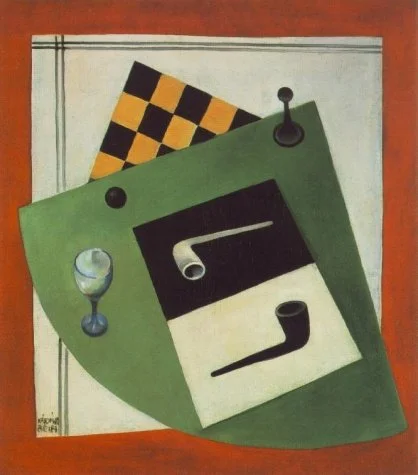
Still-life with Chessboard and Pipe by Bela Kadar (1920)
Characters
Perry Weiss — a painter in his mid-40s.
Alvin Goldstein — Perry’s best friend and chess partner, also a painter in his mid-40s.
Schiller — Perry and Alvin’s friend, mid-40s, also a painter.
Monica — A twenty-something poet and Schiller’s girlfriend, a ‘beatnik’ poet.
Various extras — Bar patrons, beatniks at an art gallery.
Bethune Street, Greenwich Village, New York City
Winter, 1955
Scene One — Perry’s Apartment
Curtain rises to reveal a very small one-bedroom apartment with a nonworking fireplace, of which an old photo of a young woman sits on the mantel alongside a small radio; a brick wall adorned with small works of art, a green threadbare carpet, a reading chair, a couch, a dining table, and a coffee table on which sits a chessboard. A kitchenette is separated from the living room by a short Formica counter.
Perry Weiss, early 40’s, casually dressed in a workman’s shirt and chinos, is looking out the window watching snow fall. He turns away from the window and looks at his unfinished painting sitting on. the easel. He walks over to it, touches his fingers to the paint, examines his fingertips due to the painting still being a bit tacky. He wipes the bit of paint from his fingertips to his pants, He then lights a cigarette and steps back to have a better look ay his unfinished masterpiece. Not knowing what else to do with it, he sighs, dejected, and sits down on the couch.
He stares at the painting for a long moment, then walks over to the radio and turns it on. A news report about Eisenhower and the Russians. He listens for a moment, then turns off the radio, returns to his painting.
He reaches for the brush, then pulls his hand away. After another long moment, he picks up the brush, whitewashes the entire painting.
Scene Two — Perry’s Apartment, Same Evening
Perry sets up the chessboard on the dining table, arranging both sides to have it ready for when his friend arrives. After he finishes setting up the board, he walks into the kitchen to pour himself a cup of coffee, takes a half-finihsed cake off the counter and carries it all back to the table. He returns to the kitchen for another coffee cup and the coffee pot, carries that back to the table.
There’s a knock on the door. Perry answers it.
Alvin Goldstein, 40’s, dressed in a top coat and scard iver a tweed sport’s coat, light blue shirt and paisley tie, walks into the apartment shaking the snow from his fedora, begins undoing his scarf.
ALVIN
You’re not going to believe this, but Schiller’s got a one man show.
PERRY
Schiller? Are you serious?
ALVIN
Couldn’t be more.
(He takes off his coat, hangs it on the peg og the door, along with his hat).
Imagine? Schiller of all people?
They sit down at the table . Alvin pours himself a cup of coffee. Perry slides the dish with the half-eaten cake towards him but Alvin waves it away.
PERRY
Could be worse, I suppose. Imagine if it were Kress.
ALVIN
Oh, please. Kress couldn’t get a one man show if he put it on himself.
Alvin removes a pack of cigarettes from his pocket, shakes one loose, offers one to Perry. Perry accepts it, lights it, then lights Alvin’s. They each look down at the chessboard, contemplate their next moves.
PERRY
You’re white this time. I’m sick of always being white.
ALVIN
Makes no difference to me. You’re still going to lose. You go first. I’ll give you a handicap.
PERRY
Change is always good.
Perry moves his pawn to start the game.
ALVIN
Speaking of change - I’m not sure what’s been happening lately. I just don’t understand any of it, do you?
PERRY
Not at all. I mean, if a no talent like Schiller is getting a one man show, what the hell does that tell you?
ALVIN
(Making a countermove)
It burns me up. It really does.
PERRY
The guy has no clue what he’s doing. Never has. He just follows the crowd.
ALVIN
That’s the worst thing any artist can do.
PERRY
(Contemplating his next move)
Meanwhile, we continue to struggle - and we’ve been at this a long time, longer than most. I feel like we’re sory of being kicked out of the way.
ALVIN
It’s all those young upstarts, those no talent pretenders throwing paint all over the place, calling it a painting.
PERRY
I don’t get it.
ALVIN
That makes two of us.
Perry moves his knight. Alvin watches.
ALVIN
You seem confident today. Going for the kill already?
PERRY
I’m going to beat you this time.
ALVIN
Good luck.
Alvin stares at the board, contemplates his next move.
PERRY
Seriously - Schiller’s a decent guy and all but he has absolutely no talent to speak of. He knows nothing of the masters. Like we said, he’s just following the crowd, as he’d always done, copying whatever anyone is doing at the time. When Pollock began dripping, Schiller began dripping. When Gottlieb did his so called atomic paintings, or wahtever the hell they were, Schiller did his. Ask him to do something like Monet, Degas, or Matisse - real artists, not these drunken hoodlums down at the Cedar.
ALVIN
Tell me about it.
PERRY
I mean, it looks like it takes these guys twenty minutes to paint a picture. Do they realize how much work goes into a real work of art? How much they have to know?
ALVIN
Yet look what’s happening. It’s all around us, I’m afraid. Blame Guggenheim, Castelli, and that hack Greenberg who’s always championing these maniacs. They’re the one’s to blame here.
PERRY
Don’t even get me started on Greenberg. I used to have respect for him. Somehow this new crowd managed to get to him.
ALVIN
It’s all about access. They bring him into their circle. He’s an insider now.
PERRY
Sometimes I think of packing it in and moving to Paris.
ALVIN
Paris has been dead since the war. New York is the center now.
PERRY
Well, if it is, and this is what’s being produced, I don’t want anything to do with it.
ALVIN
It’s been very difficult lately.
PERRY
Who are you telling? (He looks over at his newly whitewashed canvas.) The trouble is, I can’t seem to come up with anything new, something that shows progress. I suppose I could simply pop off one of these so-called abstractions, rip open one of my paint tubes and throw paint all over the place, but that’ll be, well…you know what I mean.
Alvin takes Perry’s knight with his.
ALVIN
Sure - but no one cares anymore. It’s not about talent. It’s about pulling something over someone’s eyes. What they do is so destructive, not constructive. You ought to see them down at the Cedar some nights, getting legless and fighting with one another, making a spectacle of themselves. For as much as they like to believe they’re the new In-Crowd, they sure have nasty shit to say about one another.
PERRY
That’s always been the case. Even in our day.
ALVIN
Ha! Our day! Seems like an eternity ago, doesn’t it?
PERRY
So Schiller has a one man show…
ALVIN
Sad, isn’t it?
They sit in silence, staring at the chessboard, each contemplating their next move.
Scene Three — Perry’s Apartment, Later the Same Evening
Alvin puts on his coat and bat, getting ready to leave. Perry stands beside him, his hand on the doorknob.
ALVIN
Don’t feel so bad. You’ll never be able to beat me, remember that.
PERRY
One day, my friend. One day.
ALVIN
You’re a far better painter than you are a chess player, my friend.
Perry opens the door for him.
ALVIN
Until next week.
Alvin leaves and Perry closes the door.
The apartment is quiet now. He looks out the window. It’s still snowing.
He begins cleaning up, clearing the table of the empty coffee pot and cups, carries the now much smaller piece of cake back to the kitchen counter. He puts the coffee pot and cups into the sink, runs water on them but leaves them for another time.
He turns to look at his whitewashed canvas sitting on the easel, then walks over to it, and picks up the paintbrush. He stands before the blank canvas and doesn’t move for a long moment, then, in frustration, puts the brush down. He lights a cigarette, looks at the stack of paintings sitting against the brick wall, next to the fireplace and begins going through them, one by one, seemingly satisfied by the work he’d been able to accomplish.
Feeling inspired again, he returns the easel, picks up the paintbrush, begins painting.
Scene Four — Bar
A dive bar full fo young people, mostly beatnik artist types, smoking cigarettes, drinking beer, and listening to a jazz record on the jukebox.
Perry enters and sees Schiller, 40s, sitting at the bar, talking to a young woman in her early 20s, very attractive with dark hair, black shirt, and tight black skirt, a beatnik type who carries herself with a bit of an attitude.
Upon Schiller, Perry wants to turn and leave but Schiller sees him, waves him over.
SCHILLER
Hi ya, Perry, how are you doing? Long time no see. (He shades Perry’s hand,) Let me introduce you to my new friend. (He turns to the young woman.) Monica, this is Perry, a fellow artist and a long time friend. Perry, Monica. Monica is a poet. Seems to be a lot of them around, these days.
PERRY
(Shaking Monica’s hand)
A poet, huh? What kind of poetry?
MONICA
(A bit smug)
Free verse, mostly, but I work in other forms as well.
PERRY
Have you published anything? Anything I can read?
MONICA
I’ve only published one poem so far.
PERRY
Nice. Where in?
MONICA
Oh, it’s a small magazine. You probably never heard of it.
PERRY
Try me.
SCHILLER
Perry’s up on these things. Don’t let the grey in his hair fool you.
MONICA
Crossroads. It doesn’t have much of a circulation, but it’s a start. I’m happy.
PERRY
I know Crossroads. It’s a very good literary journal. Congratulations. They must think very highly of you to be published there. It’s not easy getting work accepted there. It’s not easy getting work accepted there.
Monica smiles, looks him up and down, a big judgmental.
PERRY
Which issue? I’d love to reach it.
MONICA
It was in the November issue.
PERRY
I think I have that one. Your name, Monica…
MONICA
Brandão.
PERRY
Brandão. I’ll be sure to look.
SCHILLER
What’s your pleasure, Perry?
PERRY
A beer is enough, thank you.
Schiller orders a beer for Perry. The bartender fills the glass from the tap, slides it across the bar. Schiller hands Perry the glass.
PERRY
I want to congratulate you, Schiller. On your one man show.
SCHILLER
So you’ve heard.
He taps his glass to Schiller’s.
PERRY
When and where is the opening?
SCHILLER
Not for a couple weeks. The gallery is new. Over on the east side.
PERRY
Which one?
SCHILLER
Oh, I don’t remember, something like the East Side Arts or East Side something or other. There really isn’t much happening over there but hey, I’m not complaining.
PERRY
How did you manage it?
SCHILLER
It was just one of those things. I was talking to someone here a few weeks ago and he happened to know a guy who was starting up a new gallery on the east side and we just got to talking. He came back one night with Sal, the owner of the gallery, and he expressed interest in seeing some of my work. I figure, why not, and took him around to my studio. The next thing I knew, he offered me a show. Imagine? Never had that happen before. Never had that happen ever.
PERRY
Happy to hear it, Schiller. What work are you doing for the show?
SCHILLER
I’m not doing anything. He chose the work he wanted. Mostly newer work anyway. He liked the older work too, but he was more impressed with my recent work. (He sips his beer.) What about you? What have you been working on lately?
PERRY
A few things, trying out some new ideas.
SCHILLER
(To Monica)
You have to see Perry’s work. It’s amazing. Hey! Maybe we can swing by your place and have a look.
PERRY
Some other time. The place is a mess right now and everything is disorganized. Tonight’s not good. I also have a work in progress on the easel and you know how I feel about that.
SCHILLER
Sure, I understand. Another day, then. (He gulps down his beer, stands up.)
If you’ll excuse me, Monica and I have a dinner date. (Shakes Perry’s hand.) It was good seeing you again, Perry. Be sure to come to the opening. I’ll let you know when it is. And bring Alvin with you as well. I haven’t seen him in a dog’s age.
PERRY
I’ll be sure to let him know. (To Monica.) Pleased to meet you. I’ll be sure to read your poem.
Perry watches Schiller and Monica walk towards the exit. He sits on Schiller’s stoll, cozies up to the bar, lights a cigarette and quietly finishes his beer.
Scene 5 — Perry’s Apartment, Later that Night
Perry looks through a stack of magicians at the dining table, setting them aside with the intention if tossing them out. Among them is in the November issue of Crossroads.
He opens the cover, scans the index for Monica’s name. When he finds it, he immediately turns the to the page it’s on, removes his reading glasses from his shirt pocket, put them on and begins reading. We don’t know what the poem says, nor do we see it. Only Perry’s reaction to it, as he slowly raises his head from the page, his expression one of disgust and disbelief.
He tosses the magazine aside and approaches the whitewashed canvas on the easel. He stands before it, paintbrush in his hand. He stares at the blank space for a long moment, the brush poised to make a mark, but nothing happens.
Scene Six — Perry’s Apartment, One Week Later
Perry and Alvin are sitting at the dining table over another game of chess. The coffee pot, coffee cups, and a near full loaf of cake on the table.
ALVIN
You don’t have a prayer (He moves his bishop across the board. Perry reacts to the move, frustrated.) I saw Miller yesterday. Says you ran into Schiller at the bar last week.
PERRY
Miller was there? I didn’t see him.
ALVIN
I suppose so. He didn’t say anything about it. But apparently he knew you saw him.
PERRY
Maybe Schiller told him. I didn’t see Miller at the bar.
ALVIN
Maybe…
Perry moves his rook a few spaces.
PERRY
Schiller’s running around with some kid. A poet.
ALVIN
Really? How young?
PERRY
Half his age, at least.
ALVIN
We should be so lucky. (He moves his bishop back two spaces.) What kind of poet?
PERRY
She’s terrible, Al. She has a poem in Crossroads, if you can believe it.
ALVIN
Crossroads? Really?
PERRY
How she got published there is beyond me.
ALVIN
Is it that bad?
Perry stands up and walks over to the couch, retrieves it, opens it to the page where Monica’s poem appears. He hands Alvin the magazine and Alvin begins reading it.
ALVIN
(Perplexed)
What is this shit? Crossroads published this gobbledegook?
PERRY
You see it, don’t you?
ALVIN
(Turning to the first page to read the masthead)
Wilson’s still the editor? Has he gone out of his mind? (He tosses the magazine aside.) It’s like the literary equivalent to all these paintings. I can’t believe Wilson, of all people, would accept anything like that. What’s he thinking? Tell me, is she pretty?
PERRY
Very much so.
ALVIN
And there you have it. (He moves his bishop again, taking Perry’s rook.) Careful. You’re leaving yourself dangerously open.
PERRY
I’m not out of it just yet, my friend. (He moves a pawn.) I’ve been very frustrated lately. I can’t seem to finish anything.
ALVIN
It happens to the best of us. Don’t beat yourself up over it.
PERRY
I never had such a dry spell. Not for this long.
ALVIN
It’ll come, you know that.
Perry moves his knight.
ALVIN
And he’s victorious once again! Checkmate, my friend.
Scene Seven — Art Gallery
It’s a storefront gallery on the Lower East Side. There is a small crowd of young people, mostly in their 20s. Perry and Alvin walk through the doors to discover they are the oldest ones there. Schiller’s work lines the walls, all of it black and white abstractions.
ALVIN
(Looking around in disbelief)
This is shit.
They work their way further into the gallery, pushing through this younger, hipper crowd, looking at the paintings one by one.
ALVIN
Absolute shit. Are you fucking kidding me? I’m…I’m speechless. I don’t know what to say.
They see Schiller at the far end of the gallery, dressed entirely in black, glass of wine in his hand, holding court with Monica and three other young women about her age.
PERRY
Let’s get the hell out of here. I can’t take this.
As they turn to leave, Schiller sees them heading for the exit. He doesn’t stop them but the expression on his face and his body language reveals disappointment. He turns to Monica and the others, forces a smile, continues to entertain them.
Scene Eight — Perry’s Apartment, Same Evening
Perry enters the apartment, slowly removes his coat and hat, hangs them on the peg on the door.
He turns on the lights, lights a cigarette, and walks over to the burgeoning painting on his easel.
He stares at it a moment, then picks up the brush and whitewashes it again. He just stands there, staring at the blank canvas.
Curtian.
About the playwright:
Julian Gallo is the author of 'Existential Labyrinths', 'Last Tondero in Paris', 'The Penguin and The Bird' and other novels. His short fiction has appeared in The Sultan's Seal (Cairo), Exit Strata, Budget Press Review, Indie Ink, Short Fiction UK, P.S. I Love You, The Dope Fiend Daily, The Rye Whiskey Review, Latinoture, Angles, Verdad, Modern Literature (India), Mediterranean Poetry (St. Pierre and Miquelon), Borderless Journal (Singapore), Woven Tales, Wilderness House, Egophobia (Romania), Plato’s Caves, Avalon Literary Review, VIA: Voices in Italian Americana, The Argyle, Doublespeak Magazine (India), Bardics Anonymous, Tones of Citrus, The Cry Lounge (Germany), Deal Jam, 22/28, Active Muse (India), Zero Readers, Hominum Journal, Write Now Lit (Nigeria), MiniMAG, Paradox Magazine, Penman Review, Lowestoft Chronicles, Marrow Magazine, Lanae Literature and Review, Helix Literary Magazine, Interweaved Magazine, Flora Fauna (Upcoming), and Pattern Recognition (Upcoming).